No-fault in Florida: Who pays when a car accident leaves you injured?
After a car accident, most people have the same questions: Who pays for my medical bills? Will my insurance cover my expenses? Do I need to file a claim against the other driver?
If you live in or drive in Florida, you have likely heard that auto insurance works differently here than in most other places. Is Florida a no-fault state? Yes, it is. Florida is one of a handful of states that uses a no-fault system for motor vehicle crashes.
However, the phrase "no-fault" confuses many drivers. It does not mean nobody is responsible for causing a crash. It also does not mean you can never hold a reckless driver accountable for severe injuries. Instead, it refers to how your insurance company handles initial financial costs after a collision.
When you are hurt in a crash, dealing with insurance companies is one of the most frustrating parts of the process. If you have questions about your rights after a crash, call our team at Osborne, Francis & Pettis today at (561) 293-2600 or fill out our online form for a free case evaluation.
What Does It Mean To Be A No-Fault State?
In a traditional "fault" state, the driver who causes the accident is financially responsible for the damage and medical expenses of everyone involved.
However, to get your bills paid in a fault state, you typically have to file a claim with the other driver’s insurance company, prove that they caused the crash, and wait for them to process the claim before seeing any money for your recovery.
Florida works differently. In our state, every driver carries insurance designed to cover their own medical care and lost earnings first, regardless of who caused the crash.
For example, if you get rear-ended while stopped at a red light, your own auto insurance policy pays for your initial emergency room visit and time missed from work, up to your policy limits.
So, what does it mean to be a no-fault state when it comes to daily life on the road? It means:
Your insurance pays first: You look to your own policy’s Personal Injury Protection (PIP) coverage before turning to anyone else.
Fault is bypassed for routine medical bills: You do not have to wait for insurance companies to argue over fault before getting financial help for urgent medical care.
Property damage is treated differently: The no-fault system applies specifically to personal bodily injuries, not to physical damage to your car. The at-fault driver’s insurance is still responsible for fixing your vehicle.
Why Is Florida a No-Fault State?
Florida was not always a no-fault state. Our state adopted the Florida no-fault law back in 1972.
To understand why Florida opted for this system, it helps to look at the past. Before the no-fault law, even relatively minor car accidents often led to lawsuits over medical expenses and other losses. That created delays in the court system and slowed down payments for injured drivers to even get basic medical payments.
Lawmakers created the no-fault framework with three main goals in mind:
Faster payments for medical care
Reduced court congestion
Guaranteed basic protection
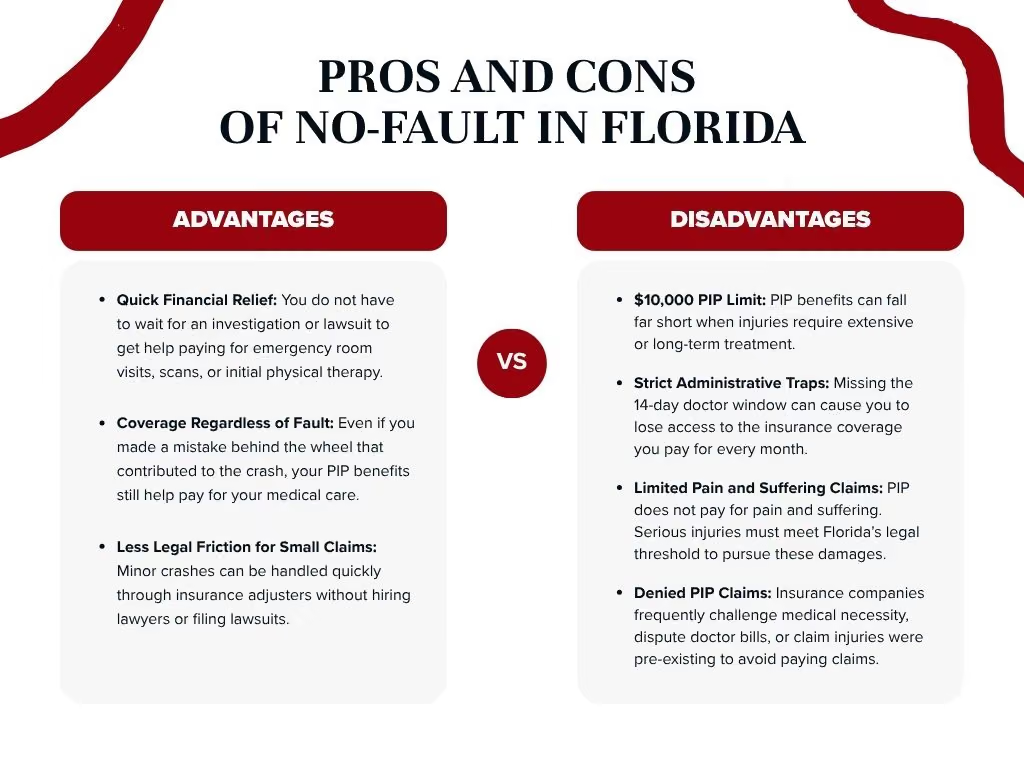
While the law achieved its goal of speeding up small payouts, it also created new challenges for drivers who suffer serious injuries. The $10,000 PIP limit established in the 1970s remains the same today, despite fifty years of rising medical costs.
Florida Insurance Requirements Under Its No-Fault Law
To legally register and drive a four-wheeled vehicle in Florida, most drivers must carry at least:
$10,000 in Personal Injury Protection (PIP) to help pay for their own medical expenses and certain lost wages after a crash, regardless of who caused it.
$10,000 in Property Damage Liability (PDL) to pay for damage you cause to another person's vehicle or other property.
Understanding Your Personal Injury Protection (PIP) Benefits
PIP insurance acts as your first line of defense after a crash. However, having $10,000 in PIP coverage does not mean the insurance company simply hands you a check for $10,000. The law places strict conditions on how and when those benefits are paid:
The 80% Medical Rule: PIP covers 80% of reasonable, medically necessary treatment costs. You are responsible for the remaining 20% out of pocket or through health insurance.
The 60% Lost Wage Rule: If your injuries prevent you from working, PIP reimburses 60% of your lost income.
The 14-Day Medical Window: This is one of the most critical parts of the Florida No-Fault Law. You must seek initial medical treatment within 14 days of the accident. If you wait until day 15 to see a doctor or go to urgent care, your insurance company can legally refuse to pay any PIP benefits.
The Emergency Medical Condition (EMC) Requirement: To access the full $10,000 PIP benefit, a licensed physician, physician assistant, or nurse practitioner must diagnose you with an "Emergency Medical Condition" (EMC). An EMC means your injury threatens your health, bodily functions, or organs without immediate care. If your injuries are not classified as an EMC, your PIP payout is capped at just $2,500
Exceptions Under No-Fault Law in Florida
Florida’s no-fault system does not mean that bodily injury liability insurance is never required, and it does not apply to every type of vehicle. There are important exceptions that can change what insurance coverage is available after a crash.
For most drivers, Florida law does not require a standard personal auto policy to include Bodily Injury Liability (BIL) coverage. BIL insurance pays for injuries you cause to another person when you are legally responsible for a crash.
However, certain drivers and vehicles must carry BIL insurance, often with higher coverage limits.
Taxi vehicles are one example. Vehicles registered as taxis in Florida must carry at least $125,000 in bodily injury liability coverage per person, $250,000 per accident, and $50,000 in property damage liability coverage. These requirements recognize that taxis are commercial vehicles that regularly transport members of the public.
There are also special requirements for drivers convicted of certain offenses. A person convicted of a DUI within the previous three years must carry at least $100,000 in bodily injury liability coverage per person, $300,000 per accident, and $50,000 in property damage liability coverage. These requirements apply during the specified period following the conviction.
What If You Were Riding a Motorcycle?
Motorcycles are not covered by Florida’s no-fault PIP system in the same way as four-wheeled vehicles. As a result, a motorcyclist who is injured in a crash generally cannot rely on standard PIP benefits to cover medical expenses and lost income.
There is an important exception: a motorcycle rider may have PIP or other applicable coverage if they purchased optional insurance that provides those benefits. Without that coverage, an injured motorcyclist may need to pursue damages from the driver who caused the crash and look to any available liability insurance.
What If I Am Partially At-Fault for the Accident?
Being at fault for a Florida car accident does not automatically mean you lose your PIP benefits. Florida’s no-fault law generally allows you to use your own PIP coverage for covered medical expenses and lost income, even when you caused the crash.
The law does provide certain exclusions, including injuries a person intentionally causes to themselves or injuries sustained while committing a felony.
This can apply to many common types of crashes, including rear-end collisions, sideswipes, left-turn accidents, lane-change crashes, and accidents caused by failing to yield or obey a traffic signal.
But being at fault does matter when you are trying to recover damages from someone else. If another person also contributed to the accident, Florida's modified comparative fault rule may allow you to recover damages if you are 50% or less at fault. Your recovery is reduced according to your percentage of fault. If you are found to be more than 50% responsible, you generally cannot recover damages in an ordinary negligence case.
There is another important distinction: if the other person suffered serious or permanent injuries, Florida's no-fault rules may allow them to pursue a claim against the at-fault driver beyond their PIP benefits. In that situation, the available insurance coverage and the facts of the crash become especially important.
So, being labeled the “at-fault driver” does not necessarily end the conversation. Fault can be disputed, shared between multiple parties, or based on evidence that may not be clear immediately after a crash.
If you were injured in an accident and believe you may have contributed to it, it is worth having an attorney review what happened before assuming you have no legal options. Call Osborne, Francis & Pettis at (561) 293-2600 or fill out our online form. There are no fees unless we win.
What If the Other Person Who Hit You Has No Insurance or Is Underinsured?
Florida requires drivers to carry certain auto insurance, but that does not mean the driver who hits you will have enough insurance to cover your injuries. In fact, most Florida drivers are not required to carry Bodily Injury Liability (BIL) coverage. That can leave injured drivers with a difficult question: If the person who caused my accident cannot pay for my injuries, where can I turn?
Your first source of coverage is generally your own PIP insurance. PIP can help with your initial medical expenses and lost income, but serious injuries can quickly exceed those limits.
Uninsured and Underinsured Motorist Coverage
This is where Uninsured/Underinsured Motorist (UM/UIM) coverage can become especially important. Florida law generally requires insurers that sell policies with bodily injury liability coverage to offer UM coverage, although policyholders may reject or select lower limits in writing.
UM/UIM coverage is designed to protect you when the driver responsible for your injuries does not have enough liability insurance available.
For example, suppose another driver causes a serious accident and has no BIL coverage. Your PIP benefits may cover some of your initial medical expenses and lost income, but they may not address the full value of a serious injury. If you have UM coverage, you may be able to make a claim under your own policy for covered damages, subject to your policy limits and Florida law.
The same may be true when the other driver has insurance, but the available liability limits are too low to cover your damages. That is the “underinsured” situation.
What If It Was a Hit-and-Run?
UM coverage can also be important after a hit-and-run accident. When the driver who caused the crash cannot be identified, there may be no at-fault driver's insurance to pursue. Depending on the circumstances and the requirements of your policy, your UM coverage may provide a way to seek benefits for your injuries.
Breaking Through the No-Fault Cap: Florida's Serious Injury Threshold
Many people wonder: If Florida is a no-fault state for car accidents, am I locked out of filing a traditional injury lawsuit forever?
The answer is no. Florida Statute § 627.737 provides an exception to the no-fault rule. If your injuries meet the state's legal definition of a serious or permanent injury, you can step outside the PIP system and file a personal injury lawsuit against the at-fault driver.
Under Florida law, a serious injury includes:
Significant and permanent loss of an important bodily function
Permanent injury within a reasonable degree of medical probability (such as spinal disc herniation, nerve damage, or traumatic brain injury)
Significant and permanent scarring or disfigurement
Navigating the Florida no-fault law requires clear direction, especially when dealing with pushy insurance adjusters, short deadlines, and disputed medical bills.
Here is how Osborne, Francis & Pettis can guide you through a Florida auto accident claim:
Protecting Your PIP Rights: We make sure your medical treatment is documented properly within the 14-day window and get the necessary documentation to unlock your full $10,000 benefit.
Investigating the Crash: We gather critical crash site evidence, witness statements, camera footage, and police reports to prove fault when stepping outside the PIP system.
Establishing the Serious Injury Threshold: We work with your doctors and medical specialists to show the permanent nature of your injuries, opening the door for full financial recovery.
Uncovering All Insurance Sources: We explore every possible avenue of financial recovery, including the at-fault driver's policy, commercial policies, and your own UM/UIM coverage.
Standing Up to Insurance Corporations: Big insurance companies know our reputation, and we do not back down when fighting for our clients.
If you or someone in your family was injured in a crash, let us help you explore your legal options. Contact our experienced Florida personal injury team today at (561) 293-2600 or fill out our online form to schedule your free, confidential consultation.
Proudly Representing Florida Residents Statewide
Boca Raton
Orlando
Lakeland
West Palm Beach
Ft. Lauderdale
Related Resources
If you found this car accident content helpful, please view the related topics below:
Quick and fair resolution to a unique case. On advice of my own attorney, I engaged Joseph Osborne of Osborne & Francis of Boca Raton, FL. Mr. Osborne had considerable experience in cases such as mine and the results showed that. Mr. Osborne and his staff were very helpful, kept me up to date, and listened to my input. The settlement was very fair as far as I am concerned.
- Alfred
This Firm was very helpful and transparent I really appreciate their work and effort representing me! My case manager Jennifer was very good at keeping me informed on developments and updates. And my attorney Christina was very strong in her representation of me and my beliefs, so I definitely want to give them shouts and to all that was apart of my case. I really appreciate you!
- A. Wilson
Attorneys Greg Francis and Ryan Fletcher at Osborne, Francis & Pettis Law Firm represented me in my personal injury case.The defendant drew a line in the sand and was adamant on a settlement amount I was almost willing to accept. After the dust settled and the smoke cleared, we settled for 3 times that amount!!! When they say ‘Real Tough Lawyers,’ they mean it.
Oops! Something went wrong while submitting the form.
Why People Trust Osborne, Francis & Pettis
C. Smith
“I am so thankful for EVERYONE, the entire staff at Osborne & Francis Law, for mentoring me through the mediation process with my hip replacement failures. I didn't realize how MUCH pressure they relieved me of by helping me deal with the reality of this traumatic time in my life, as it was OVER so quickly with a positive result. My family is grateful to have their mom HAPPY & FOCUSED on the future, rather than worrying over what happened in the past! FAST FORWARD, we are LIVING LIFE to the fullest once again!”
T. Andrews
“Attorneys Greg Francis and Ryan Fletcher at Osborne & Francis Law Firm represented me in my personal injury case. The defendant drew a line in the sand and was adamant on a settlement amount I was almost willing to accept. After the dust settled and the smoke cleared, we settled for 3 times that amount!!! When they say ‘Real Tough Lawyers,’ they mean it.”
Alfred
Quick and fair resolution to a unique case. On advice of my own attorney, I engaged Joseph Osborne of Osborne & Francis of Boca Raton, FL. Mr. Osborne had considerable experience in cases such as mine and the results showed that. Mr. Osborne and his staff were very helpful, kept me up to date, and listened to my input. The settlement was very fair as far as I am concerned.
Erica F.
"Best personal injury attorney around, I could not be happier! I was seriously injured in a car accident and Osborne and Francis helped me through the entire process. I was blown away by how knowledgeable the staff and attorneys are at this incredible law firm. I would not hesitate to recommend this law firm to friends and family!"
Hiring a lawyer is the first step towards recovering a better quality of life. At Osborne, Francis & Pettis, we devote our undivided attention to each client, and all communications are held in the strictest privacy. Contact us by filling out the form or calling us directly at (561) 621-1385.
Thank you! Your submission has been received!
Oops! Something went wrong while submitting the form.

.avif)


.svg)





.svg)
.svg)
.svg)
.svg)
.svg)