Serious car accidents can happen when drivers misunderstand right-of-way rules.
Four-way stops seem simple until four drivers arrive at the same time and everyone hesitates. One driver inches forward. Another waves someone through. Someone else decides to go anyway. In seconds, confusion turns into a crash.
Intersection accidents are common in Florida, and many occur because drivers misunderstand who has the right of way. A failure to yield at a stop sign can lead to T-bone collisions, side-impact crashes, and serious injuries that leave victims dealing with medical bills, lost wages, and insurance disputes.
If you have ever wondered who has the right of way at a four-way stop, the answer depends on timing, position, and direction of travel. Understanding these rules can help you avoid accidents and protect yourself if another driver causes a crash.
Here is what every Florida driver should know.
Questions after a Florida intersection accident? Osborne, Francis & Pettis helps drivers understand their rights, deal with insurance companies, and evaluate whether they have a claim. Call (561) 293-2600or contact us online for a free consultation.
The Basic Rule at a Four-Way Sto
The general rule is simple: the first driver to stop is the first driver to go.
If you arrive at the intersection before anyone else and come to a complete stop, you have the right to proceed once it is safe to do so. This sounds straightforward, but problems arise when multiple vehicles arrive nearly simultaneously.
When that happens, the driver on the right usually has the right of way. This rule helps break the tie and keeps traffic moving.
Florida law establishes a legal duty for drivers approaching stop intersections: they must yield to vehicles already in the intersection or to those approaching from a close enough distance to pose a hazard. Determining who fulfilled or violated this legal duty is important, as many Florida car accident claims focus on whether a driver failed to yield.
Understanding Four-Way Stop Right of Way
Knowing the four-way stop right of way rules can help prevent hesitation and dangerous assumptions.
Here is how right of way usually works:
First to stop, first to go. The first vehicle to make a complete stop has priority.
If two cars stop at the same time, yield to the right. The driver on the left must allow the driver on the right to proceed first.
Left turns yield to straight traffic. A driver turning left must yield to oncoming traffic going straight or turning right.
Pedestrians always come first. Drivers must yield to pedestrians in the crosswalk, even if it is technically their turn to go.
These rules seem small until someone ignores them. In Florida, failure-to-yield crashes often happen because one driver assumes another is letting them through.
The Rules of a Four-Way Stop Sign in Florida
The rules of a four-way stop sign are based on predictability. Every driver is expected to follow the same pattern so others can react safely.
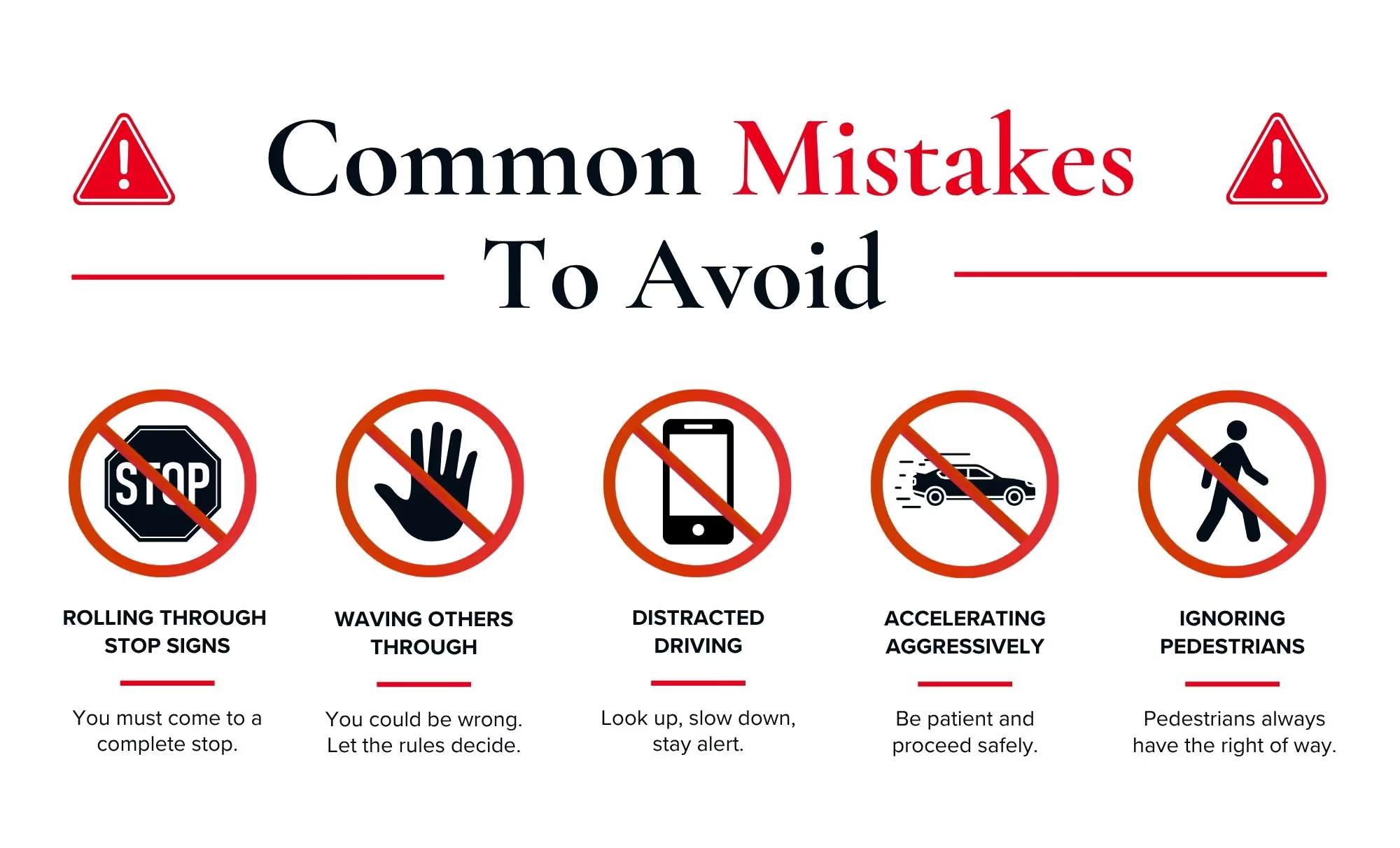
Here is where drivers often make mistakes:
Rolling stops. A rolling stop is not a legal stop. If you slow down without fully stopping, you can lose your place in the order and create confusion.
Waving other drivers through. It may feel polite, but it can create uncertainty. Other drivers may not understand your intentions.
Assuming someone will yield. Never assume another driver sees you or understands the order. Defensive driving matters, especially at busy Florida intersections.
These mistakes can quickly cause serious Florida car accidents, especially in areas with heavy traffic, tourists, or distracted drivers.
Unsure about fault at a four-way stop? Osborne, Francis & Pettis will investigate your Florida accident, gather the evidence you need, and fight for your rights. Call (561) 293-2600 now for a free consultation.
What If Two Cars Arrive at the Same Time?
This is where most confusion happens.
If two vehicles arrive and stop at the same time, the vehicle on the right goes first. That is the standard tie-breaker.
But what if four vehicles arrive together?
Technically, the same principle applies in sequence, but in the real world, drivers often communicate through eye contact or cautious movement.
People often ask, at a four-way stop, who has the right of way if everyone stops together. The safest answer is to proceed carefully, communicate clearly, and avoid aggressive moves. If another driver acts unpredictably, let them go rather than forcing the issue. A few seconds of delay is better than a collision.
Who Is at Fault in a Four-Way Stop Accident?
Fault in a four-way stop accident usually comes down to one question: who failed to yield?
Insurance companies look at several factors, including:
Police reports,
Witness statements,
Traffic camera footage,
Vehicle damage patterns, and
Driver statements.
In Florida, comparative fault may apply. That means more than one driver can share responsibility for a crash.
For example, if one driver rolled through the stop sign and another accelerated aggressively without checking for cross traffic, both may share fault. This can affect how much compensation you recover in a Florida car accident claim.
That is why evidence matters. The sooner you involve an attorney, the better your chances of preserving evidence and protecting your claim.
What to Do After a Four-Way Stop Accident in Florida
If you are involved in an intersection crash:
Call 911. A police report creates an official record of what happened.
Take photos. Capture vehicle positions, damage, stop signs, skid marks, and road conditions.
Get witness information. Independent witnesses can help establish who had the right of way.
Seek medical care. Florida’s Personal Injury Protection (PIP) law requires treatment within 14 days.
Do not admit fault. Even saying “I thought you were going” can be used against you.
Stop sign accident claims often involve conflicting stories, so strong evidence is critical when proving who failed to yield.
Injured in a Florida Four-Way Stop Accident? Call Osborne, Francis & Pettis
Knowing the right of way rules can help prevent crashes, but you cannot control what other drivers do. When someone ignores the law, runs a stop sign, or fails to yield, the injuries can be life-changing.
At Osborne, Francis & Pettis, our Florida car accident attorneys fight for injured drivers and passengers after intersection crashes. We investigate the accident, deal with the insurance company, and pursue compensation for medical bills, lost wages, and pain and suffering.
If you were injured in a Florida car accident at a four-way stop, call (561) 293-2600 to start your free case review. The sooner you act, the sooner we can start protecting your claim.
Related Resources
If you found this car accident content helpful, please view the related topics below:
Quick and fair resolution to a unique case. On advice of my own attorney, I engaged Joseph Osborne of Osborne & Francis of Boca Raton, FL. Mr. Osborne had considerable experience in cases such as mine and the results showed that. Mr. Osborne and his staff were very helpful, kept me up to date, and listened to my input. The settlement was very fair as far as I am concerned.
- Alfred
This Firm was very helpful and transparent I really appreciate their work and effort representing me! My case manager Jennifer was very good at keeping me informed on developments and updates. And my attorney Christina was very strong in her representation of me and my beliefs, so I definitely want to give them shouts and to all that was apart of my case. I really appreciate you!
- A. Wilson
Attorneys Greg Francis and Ryan Fletcher at Osborne, Francis & Pettis Law Firm represented me in my personal injury case.The defendant drew a line in the sand and was adamant on a settlement amount I was almost willing to accept. After the dust settled and the smoke cleared, we settled for 3 times that amount!!! When they say ‘Real Tough Lawyers,’ they mean it.
Oops! Something went wrong while submitting the form.
Why People Trust Osborne, Francis & Pettis
C. Smith
“I am so thankful for EVERYONE, the entire staff at Osborne & Francis Law, for mentoring me through the mediation process with my hip replacement failures. I didn't realize how MUCH pressure they relieved me of by helping me deal with the reality of this traumatic time in my life, as it was OVER so quickly with a positive result. My family is grateful to have their mom HAPPY & FOCUSED on the future, rather than worrying over what happened in the past! FAST FORWARD, we are LIVING LIFE to the fullest once again!”
T. Andrews
“Attorneys Greg Francis and Ryan Fletcher at Osborne & Francis Law Firm represented me in my personal injury case. The defendant drew a line in the sand and was adamant on a settlement amount I was almost willing to accept. After the dust settled and the smoke cleared, we settled for 3 times that amount!!! When they say ‘Real Tough Lawyers,’ they mean it.”
Alfred
Quick and fair resolution to a unique case. On advice of my own attorney, I engaged Joseph Osborne of Osborne & Francis of Boca Raton, FL. Mr. Osborne had considerable experience in cases such as mine and the results showed that. Mr. Osborne and his staff were very helpful, kept me up to date, and listened to my input. The settlement was very fair as far as I am concerned.
Erica F.
"Best personal injury attorney around, I could not be happier! I was seriously injured in a car accident and Osborne and Francis helped me through the entire process. I was blown away by how knowledgeable the staff and attorneys are at this incredible law firm. I would not hesitate to recommend this law firm to friends and family!"
Hiring a lawyer is the first step towards recovering a better quality of life. At Osborne, Francis & Pettis, we devote our undivided attention to each client, and all communications are held in the strictest privacy. Contact us by filling out the form or calling us directly at (561) 621-1385.
Thank you! Your submission has been received!
Oops! Something went wrong while submitting the form.
.avif)



.svg)




.svg)
.svg)
.svg)
.svg)
.svg)