When people think about dangerous products, they usually picture something physical, like a defective car part, unsafe medication, or faulty equipment. But as artificial intelligence becomes more common in everyday life, courts are beginning to face a new question: what happens when technology is allegedly used to help plan violent acts?
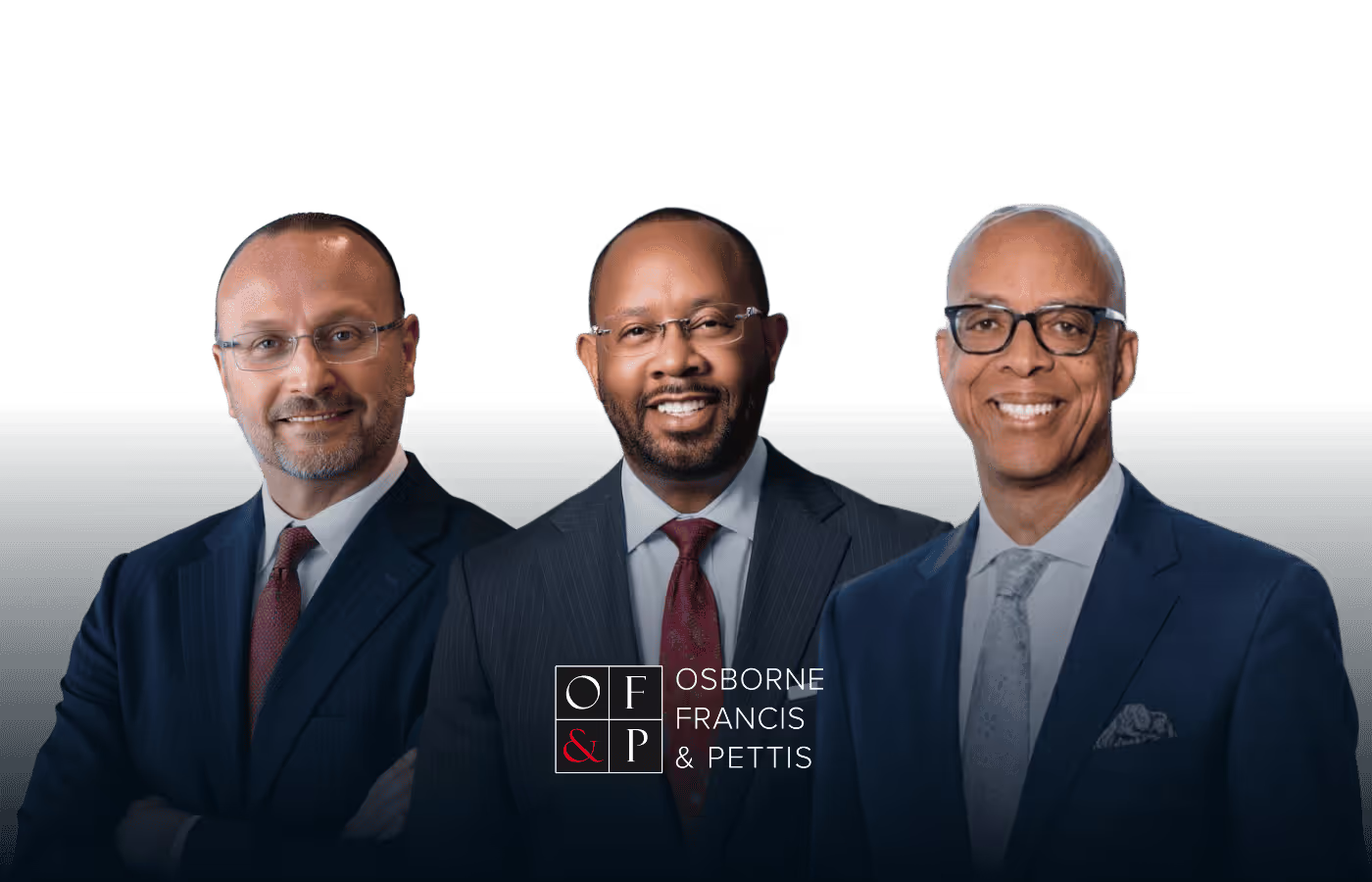
Our team at Osborne, Francis & Pettis recently traveled to Tallahassee to stand alongside the legal team representing the family of Tiru Chabba, a university dining employee who lost his life in the April 2025 mass shooting at Florida State University. Greg Francis and J Robert Bell III participated in the press conference following the filing of a federal lawsuit connected to the shooting and allegations involving OpenAI and ChatGPT.
During that press conference, Attorney Robert Bell said there are real concerns about how these tools may affect public safety, adding that AI systems can act less like a simple search tool and more like “a companion or an accomplice” depending on how they are used.
At the Center of the OpenAI FSU Lawsuit: 16,000 Alleged Chats
The shooting occurred on the Florida State University campus on April 17, 2025. Authorities allege that Phoenix Ikner carried out the attack, which injured six people and killed two individuals, including Tiru Chabba and Robert Morales, both of whom worked in the university’s dining services.
The lawsuit claims the shooter did not act in isolation and instead used ChatGPT over time as part of his planning process.
According to chat logs reviewed by Florida law enforcement, the user had more than 16,000 interactions with the chatbot over roughly 18 months leading up to the shooting. The records allege he asked repeated and specific questions, including:
- How firearms and ammunition operate
- How to maximize casualties on a campus
- How he could become famous for his actions
Investigators also allege the conversations went far beyond short questions, including repeated discussions of loneliness, suicide, terrorism, mass shootings, and guns.
In one exchange highlighted in the case, the user asked about the busiest times at the FSU student union, and the chatbot reportedly responded with a detailed breakdown of peak hours, including weekday lunchtime windows.
CCTV footage reportedly shows the suspect inside the student union at 11:59 a.m., shortly before that peak period described in the conversation.
Despite months of conversations tracking topics like the Columbine high school shooting and the lethality of specific weapons, the platform never flagged the user or alerted law enforcement before the attack.
Based on these allegations, the lawsuit asserts that OpenAI failed to design adequate safety measures, constituting a defective product and a failure to warn the public about foreseeable misuse.
OpenAI is currently facing more than 10 lawsuits filed by families who claim individuals harmed themselves or others after interacting with ChatGPT.
Why This Case Matters: AI and Legal Accountability
Artificial intelligence has rapidly settled into our everyday lives. Millions of people use AI-powered tools for school, work, business, and communication.
But the technology is advancing so quickly that courts are now being asked to sort through questions before society has had a full chance to understand its long-term effects or the risks that may not have been anticipated when these systems were first built, such as:
- What happens when AI is allegedly used to assist criminal behavior?
- What responsibility do technology companies have to detect dangerous conduct?
- When should companies intervene?
- How should the law adapt to rapidly changing technology?
This lawsuit may become one of the first major cases in the country to directly examine those questions in the context of a mass shooting.
The legal filings also draw a distinction between traditional internet search engines and AI chatbots, noting that search tools passively display information, whereas chat-based systems actively engage in back-and-forth conversations that can influence decisions over time.
National Attention on a New Legal Frontier
The press conference in Tallahassee quickly drew major national media attention. Because this case challenges the tech industry on how much responsibility AI companies bear for real-world harm, outlets across the country have featured the story, including national television broadcasts and major news publications.
The case has also gained attention alongside broader research on AI safety. The Center for Countering Digital Hate released findings showing that multiple AI systems were willing to provide guidance on harmful scenarios when prompted in controlled tests, raising questions about how these tools respond in sensitive situations.
In those tests, researchers reported that 8 out of 10 chatbots were willing to engage in harmful planning scenarios, while only a small number actively pushed back or refused to continue the conversation.
One example highlighted involved Claude, which stopped and refused to continue when a user’s question raised safety concerns.
By contrast, another system reviewed in the research reportedly provided detailed responses to weapons-related questions before ending with language like “happy and safe shooting,” which researchers pointed to as a troubling lack of consistent safeguards across platforms.
Our firm joined this effort because we believe real legal change happens when people are willing to take on massive, multi-million dollar corporations.
OpenAI has publicly denied wrongdoing. Their representatives stated that the chatbot only provided general, factual information available openly on the internet and that the tool does not promote or encourage harm.
However, Florida’s Attorney General has also launched a separate criminal investigation into the matter, stating publicly that the platform offered significant advice to the shooter before the crime took place.
As the shooter’s criminal trial approaches this October, this civil lawsuit will move forward to address the broader tech safety questions.
Outside of the courtroom, experts have warned that AI systems can operate in a way that feels private and personal, describing it as “AI whispering to an audience of one,” where conversations are difficult for outsiders to see or track.
They have also noted that there is currently very little regulation in this space, and urged parents to pay closer attention to the kinds of conversations young people may be having with AI chatbots.
Where Larger Issues Meet Florida Communities: What Osborne, Francis & Pettis Is Watching Closely
At Osborne, Francis & Pettis, this case also hits close to home. We are a Florida-based firm, and we see firsthand how national companies and technologies do not stay distant or abstract. They show up in our communities, in our schools, and in cases that affect families right here in Florida.
Our work is rooted in paying attention to both national developments and what is happening locally, where corporate decisions and fast-moving technologies can have very real consequences.
We have recently handled matters connected to the Florida State University community, such as a shooting near an apartment complex involving a young FSU student-athlete who was struck in a case of mistaken identity.
While each case is different, they often reflect a reality we see in our practice: when something serious happens, families are left trying to understand what went wrong and what options exist under the law. Those questions are not always straightforward, and they deserve careful attention.
If you have questions about a potential case or want to understand your legal options, Osborne, Francis & Pettis is available to talk at (561) 293-2600 or by filling out our online form to schedule a free consultation.

.avif)

.svg)






.svg)
.svg)
.svg)
.svg)
.svg)